

As a rural small business owner, having reliable high-speed internet is key. Broadband access, remote work infrastructure, and bridging the digital divide are vital for your success. The U.S. Chamber of Commerce notes that small businesses employ nearly half of the American workforce. This highlights the need for high-speed internet availability for them to flourish.
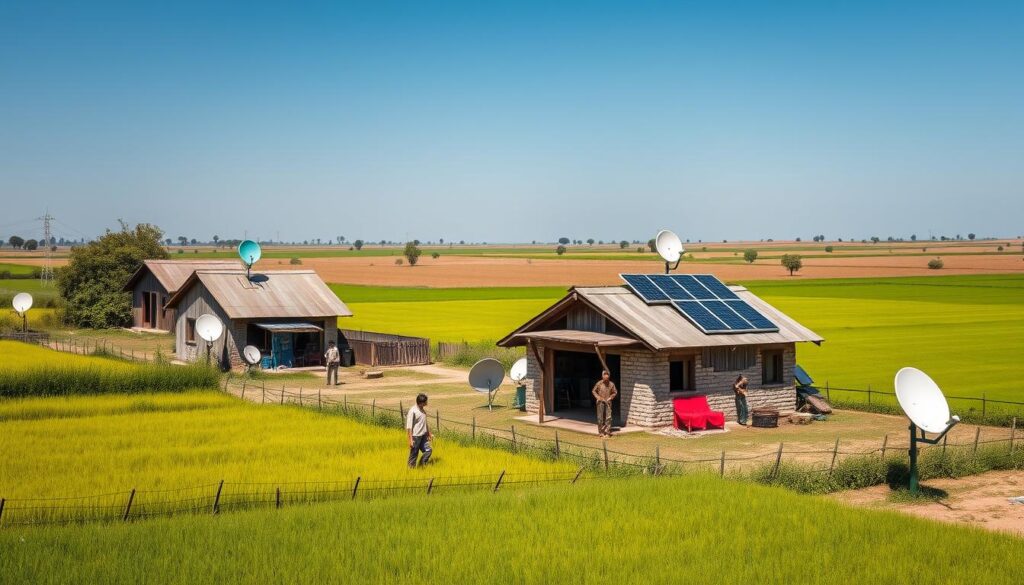
Dealing with internet issues in rural areas can be tough. But, new solutions like satellite and satellite-4G LTE are opening doors. With good internet, your rural business can meet with clients and team members anywhere. You can also use video calls and emails, and even set up an online store to reach more customers.
Key Takeaways
- Reliable internet is essential for rural small businesses to succeed, enabling improved communication, e-commerce, and employee training.
- Innovative connectivity solutions like satellite and combined satellite-4G LTE are providing new options to overcome rural broadband challenges.
- Connectivity empowers rural home businesses to hold virtual meetings, access advanced communication tools, and establish online storefronts.
- Overcoming the digital divide and ensuring high-speed internet availability are key for rural small business success.
- Reliable, low-latency internet connections can help rural businesses advance, improve customer and employee engagement, and expand e-commerce opportunities.
Understanding the Importance of Reliable Internet
In today’s world, fast and reliable internet is key for rural businesses to grow. Sadly, 17% of rural Americans don’t have broadband, unlike 1% in cities. This gap affects online business, rural growth, and fairness in internet access nationwide.
Economic Growth for Rural Areas
Good internet can change rural economies. The USDA ReConnect Program found that broadband boosts rural startups and global market access. In fact, more broadband providers mean 85 more businesses start each year. This is vital, as rural and urban entrepreneurship levels are similar.
Enhancing Remote Work Opportunities
The COVID-19 pandemic showed how vital remote work is. Rural areas need fast internet for learning, healthcare, and more. Better internet lets rural folks work, learn, and get healthcare from home.
Supporting Local Commerce
Fast internet is also key for local businesses in rural areas. Online sales can grow their customer base, increasing revenue. A McKinsey study says better internet could raise North American farm output by 8.7% by 2030.
In summary, closing the digital gap is vital for rural growth. Investing in broadband and supporting rural businesses can unlock rural America’s full promise. This will lead to a brighter future for everyone.
“Modern e-Connectivity for rural America can lead to an expansion of rural entrepreneurship and access to the global digital marketplace.”
Assessing Your Current Internet Situation
To make sure your rural home business has good internet, you need to check your current setup. Look at the types of internet connections in your area. Then, measure how fast and reliable your current service is. Lastly, think about what your business really needs.
Identifying Connection Types Available
In rural areas, you might find different internet options. These range from old dial-up and DSL to newer fixed wireless and satellite services. It’s important to research what’s available in your area to see your high-speed internet availability choices.
Measuring Internet Speed and Reliability
After finding out what connections you can get, test your internet speed. Use online tools to check your download and upload speeds, and latency. Also, watch your connection for a few days to see how reliable it is and if the speed changes.
| Activity | Recommended Bandwidth |
|---|---|
| Web Browsing | 1-3 Mbps |
| Streaming HD Video | 5-10 Mbps per stream |
| Online Gaming | 3-6 Mbps |
| Video Conferencing | 1.5-3 Mbps per participant |
| File Downloading | 5-10 Mbps |
Evaluating Your Needs as a Home Business
When checking your internet, think about your business’s needs. Consider how many employees you have and what online tasks you do. Also, think about tasks that use a lot of bandwidth, like video calls or cloud storage. Compare your current speeds and reliability to what your business needs.

“Reliable, high-speed internet is key for rural home businesses to succeed. By understanding your current internet, you can choose better telecommuting solutions and grow your business.”
Choosing the Right Internet Service Provider
As a rural home business owner, finding a good internet service provider (ISP) can be tough. There are few options in many places. It’s important to look at what services and deals are out there to meet your needs.
By comparing ISPs, reading customer reviews, and trying to get better prices, you can find the right connection for your business. This will help your business grow and succeed online.
Comparing ISPs and Their Services
When picking an ISP, think about download and upload speeds, data limits, and how reliable they are. In rural areas, you might have fewer choices. But, some notable options include:
- T-Mobile Home Internet, which covers nearly 60% of U.S. households with its non-satellite ISP services.
- Mediacom, the cheapest rural internet service starts at $15 per month for speeds up to 100Mbps.
- Ziply Fiber, the fastest multigigabit speeds of any ISP, with plans up to 50,000Mbps.
- Rise Broadband, a fixed wireless provider with faster fiber speed tiers available in select areas for gigabit speeds.
Exploring Customer Reviews and Satisfaction
Customer reviews and satisfaction ratings can give you a good idea of an ISP’s service quality. Look at independent review sites to see what other rural business owners say. A provider’s customer support is key to keeping your internet stable.
Negotiating Better Deals for Your Business
Use your business status to get better prices and service packages from ISPs. Many providers offer discounts or bundle deals for business customers who sign long-term contracts. Knowing your specific needs can help you find a solution that fits your budget and supports your business growth.
| ISP | Speeds | Data Caps | Price Range |
|---|---|---|---|
| T-Mobile Home Internet | Up to 100Mbps | Unlimited | $50/month |
| Mediacom | Up to 100Mbps | Unlimited | $15/month |
| Ziply Fiber | Up to 50Gbps | Unlimited | $60/month |
| Rise Broadband | Up to 1Gbps | Unlimited | $50/month |
Leveraging Satellite Internet Solutions
Satellite internet is changing the game for rural areas. It’s a cost-effective way to bring reliable internet to places where other methods can’t reach. This is a big step towards closing the digital divide.
Benefits of Satellite Connectivity
Satellite networks are great for rural businesses. They provide global coverage and are less affected by natural disasters. They also act as a backup for important connections, making the system more reliable.
Limitations and Considerations
There are some downsides to satellite internet. GEO satellites can have higher latency than land-based options. But, LEO satellites like those from SpaceX (Starlink), OneWeb, and Amazon (Project Kuiper) have made a big difference. They’ve cut down on latency and improved performance.
Comparing Satellites vs. Other Options
When choosing internet for your rural business, compare satellite with other options. Satellite internet is strong, but combining it with 4G LTE wireless networks is even better. This mix balances speed and data needs. Make sure your service is reliable, even when lots of people are online.

“Satellite broadband technology contributes to bridging the digital divide and fostering development in underserved regions.”
Exploring Fixed Wireless Internet Options
For rural businesses, fixed wireless internet is a big help. It uses radio waves to connect, unlike old wired systems. This makes it cheaper and easier to set up in hard-to-reach areas.
How Fixed Wireless Works
Fixed wireless sends data as radio signals from a tower to your place. It doesn’t need lots of cables. This means it’s quicker and cheaper to get started than other internet types.
Pros and Cons for Rural Businesses
- Pros:
- It’s faster to install than fiber or cable
- It’s cheaper upfront and easy to grow or change
- It can be as fast as cable or fiber internet
- Cons:
- It only works in certain areas, depending on the provider
- Weather or things in the way can cause problems
Case Studies of Successful Implementations
Fixed wireless has helped many rural businesses. For instance, Conifer Communications has brought good internet to far-off places. This has helped local businesses stay connected and access the web better.
| Key Statistic | Data Point |
|---|---|
| Rural Businesses Lacking Broadband | Around 20% |
| Rural Businesses Negatively Impacted by Poor Internet | 66% |
| Urban vs. Rural Cloud Computing Adoption | 47% (urban) vs. 32% (rural) |

Looking into fixed wireless internet can open doors for rural businesses. It helps with online work and fast internet, boosting growth and new ideas in these areas.
Improving Your Home Network Setup
As a rural entrepreneur, making your home network better is key. It helps with reliable remote work infrastructure and smooth online business enablement. By placing your router right, using Wi-Fi extenders and mesh networks, and focusing on security, you can make your internet work well for your business.
Optimizing Router Placement
Where you put your router affects your wireless signal’s strength and reach. Place it in the middle of your home, away from things that might mess with the signal like microwaves and cordless phones. Raising the router can also spread the signal better around your workspace.
Using Wi-Fi Extenders and Mesh Networks
In big homes or properties, you might have dead spots where Wi-Fi doesn’t reach. Wi-Fi extenders can fill these gaps by boosting and sending the signal again. Or, a mesh network system uses many access points to make a strong, smooth wireless network. This ensures you stay connected everywhere in your home office.
Ensuring Security for Your Business Network
Keeping your business network safe is vital. It protects your important data and keeps your remote work infrastructure and online business enablement efforts secure. Use strong passwords, turn on encryption, and update your network often to avoid security threats. Also, think about using a VPN for extra privacy and security when working remotely.
By improving your router’s spot, using Wi-Fi extenders and mesh networks, and focusing on security, you can make a strong remote work infrastructure and online business enablement space for your rural business. These steps ensure you stay connected and keep your digital stuff safe. This lets you focus on growing and succeeding with your business.
Utilizing Community Resources for Connectivity
Building reliable internet in rural areas needs community help. Working with local governments, joining cooperatives, and finding grants can help. This way, home-based businesses in rural areas can get better internet and grow their economy.
Partnering with Local Governments
Local governments are key in improving rural internet. They invest in infrastructure and change policies for better internet access. By working with them, rural businesses can push for more broadband, making digital access fairer.
Joining Co-ops for Better Services
Rural electric co-ops are now internet providers. They use their networks to offer fast internet. Joining these co-ops can give businesses better internet at lower costs, helping the local economy.
Exploring Grants and Funding Opportunities
There are government programs that give grants for better rural connectivity equity. The USDA’s ReConnect Program has given $4 billion for rural broadband. The Infrastructure Investment and Jobs Act of 2021 has $65 billion for broadband, helping rural areas grow.
Using these community solutions, rural businesses can face internet challenges and find new ways to grow and succeed.
| Metric | Impact of High Broadband Adoption in Rural Areas |
|---|---|
| Business Growth | 213% higher compared to areas with low broadband usage |
| Self-Employment Growth | 10% higher |
| GDP Growth | 44% higher |
| Per Capita Income Growth | 18% higher |
Future-Proofing Your Internet Connectivity
As your rural home business grows, it’s key to keep your internet up to date. Focus on 5G technology and local internet updates. This will help your business stay ahead in the digital world.
The Role of 5G Technology
5G is coming and it will change rural internet. It’s faster, has lower latency, and can handle more data than 4G. This means your business can work faster, use more apps, and team up remotely without issues. Keep an eye on 5G plans in your area to see how it can help your business.
Preparing for Evolving Business Needs
Your internet needs will change as your business grows. You might need more speed and capacity for new tech and remote work. Check your bandwidth often and upgrade when needed. This keeps your business running smoothly and ready for new challenges.
Staying Informed About Local Developments
It’s important to know about internet updates in your area. Follow local news, internet providers, and community groups. They often talk about projects like the Broadband Equity Access and Deployment (BEAD) program. This helps your business use new internet tech and reach more customers.
By using 5G, preparing for new needs, and keeping up with local news, you can make your business future-proof. With the right internet plan, your rural business can grow and take advantage of new opportunities.
Strategies for Maintaining Stable Internet Connection
Keeping your internet connection stable is key for your rural home business to thrive. Testing your internet speed regularly is a good start. This ensures you get the service you pay for. Knowing common issues and how to fix them helps you avoid problems.
Regularly Testing Your Internet Speed
Use free online tools to check your internet speed often. Compare it to what your ISP promises. If it’s off, contact your ISP to fix it. They might upgrade your equipment or change your plan.
Troubleshooting Common Connectivity Issues
Issues like router placement, old equipment, or interference can affect your connection. Try moving your router, getting a new one, or finding and removing interference. Work with your ISP’s support to solve these problems fast.
When to Seek Professional Help
For tough network problems or big upgrades like Starlink, get help from an IT expert. They can help you choose the right technology for your business. This ensures your internet stays fast and reliable.

Leave a Reply